Sunday, March 18, 2018

From Untied to United (States)


This year, I'm taking AP Economics and it's safe to say I find many of the concepts hard to grasp. I took it as a classic AP, and last year during scheduling season didn't even consider the possibility of it being a struggle; just like my other social studies APs, I'd study and get the right grades.
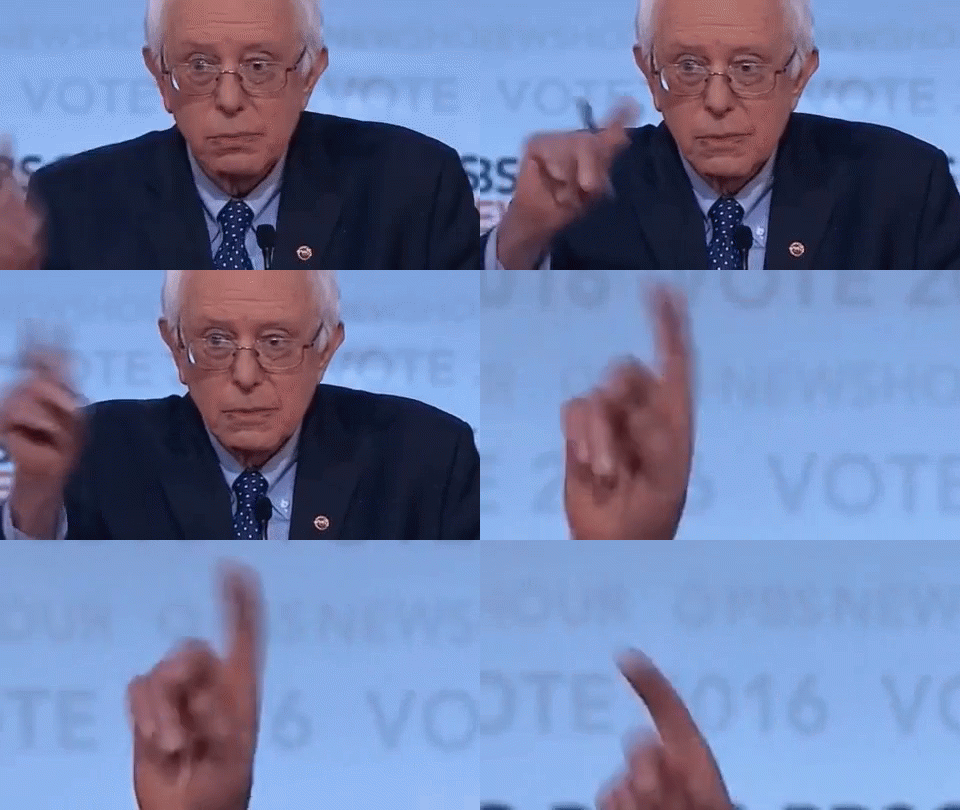
Boy, was I wrong!
Flash forward to today, and not only do I not find it interesting, but I go out of each test thinking I could either get a 94 or a 78. One thing I've heard is that those who struggle in AP Econ flourish in AP Pysch, and vice versa. To me, this makes a lot of sense. Economics, as exemplified by Thomas Sowell, is all about the "market (operating) so much more efficiently than... 'need'" (Sowell 500). On the other hand, psychology entails gaining an understanding of the human brain and the mental factors that effect human interaction. Economics completely ignores any wants, "needs", or "mushy thinking" whereas psychology literally studies it (500).

Anyways, in my opinion, economics is heartless. Free market thinkers scorn the concept of need by saying you only need a "car" if the "taxpayers" pay for it, and if it comes out of your pocket, you'd just get a "brake job". I truly don't think this is a breakthrough in disproving human need, but just shows our ability to settle. For example, suppose I had to buy lunch at school but only had $1. In one scenario, my friend offers to lend me $2 to buy the special, and in another scenario I just settled for a bag of chips. In scenario 2, I didn't need lunch any less, but had to make do with what I had. That's the situation of countless Americans around our country; they don't need a car, food, clothes, housing, any less when they settle for a bike, McDonald's, hand-me downs, and the streets. Many will think that it's not (in the scenarios) my friend's responsibility to lend me money, but in the United States of America, we should live up to that name and help each other out. There will be a time when a line needs to be drawn, but that's another discussion. As for now, Americans should help each other out and instead of being separate, distinct, and unemotional (untied), we should be communal, generous, and understanding (united).

Sunday, March 11, 2018

WATER. IS. WET.


Prompt: Analyze the two passages and write a claim comparing and contrasting the purpose of the writer.

Passage 1:

Inside a Genetics Biology Bacteriology and Embryology class, sat a group of students in the corner of the room. Wait, scratch that- stood a group of students in the corner of the room. They were passionately debating a controversial topic: the possibility of water being wet or not. The majority of the group stood in the position that water isn't wet, except for a two truth seekers. In the background, the substitute teacher stood in awe and a little bit of confusion wondering what was going on, and added the debate into her sub notes. Ironically, another GBBE teacher at the same time dropped a huge jug of water- form meeting content.

Passage 2:

AM I SURROUNDED BY IGNORANCE? Everyone around me- Justin, Paige, even my own lab partner Alicia- thought water isn't wet. Well today, I'm here to prove to all of my readers that water is INDEED wet. First and foremost I have the two GBBE teachers on my side: "any two molecules that are touching are wet". Furthermore, by the law of syllogism, fire is hot, hence water is wet. One definition of wet is "liquid that makes something damp" THEREFORE water applies in that definition! I know many of you've seen that video on twitter saying water isn't wet because "water in a water bottle can't be dried", BUT IT DEPENDS ON HOW MUCH PAPER TOWEL YOU USE. To anyone that says water can't be wet because it makes other things wet, that's just like saying fire cant be hot because it makes other things hot. If you think water isn't wet you're a confused human being, sorry.

Saturday, March 3, 2018

Don't be Salty at the Homeless


This week, we discussed homelessness and poverty by reading "On Dumpster Diving". Eigner was very blunt by simply stating, "I live from the refuse of others". The topic of giving money to the homeless came up and it reminded me of something I witnessed in Pakistan. Every instance we were on the road, be it in the congested city or the traffic lights or even on the highways there would be a homeless person. They actually walk right up to your car window, knock until you roll it down, and plead for money. This might sound tedious and a little extra but I didn't even feel attacked by it. The poverty in Pakistan is really, really bad. Shockingly, the Edhi Foundation, Pakistan's largest charity doesn't have a specific means to address homelessness just because it's too big of a problem. And sadly, my relatives who live there have gotten used to it, hence numb to it. 

They'll will go out of their way to de-emphasize this problem, saying there's a "network of bosses" who employ their impoverished lackeys to take the innocent upper classes' money. When I was in a bazaar (open market) my cousin literally debated a little boy who was eagerly trying to sell her a color book. Don't get me wrong, I love my family, but sometimes they don't recognize the privilege they're born into. In reality, their theory might actually be plausible (https://tribune.com.pk/story/540841/begging-becomes-business-in-pakistan/) , but that doesn't mean people in this form of organized crime aren't in a bad situation. People will go out of their way to talk and cry about a problem, but won't do anything to solve it. The same thing is with homelessness; we don't think it's our job to fix it, but one day the problem could possibly reach us.

Sunday, February 25, 2018

Ignorance Gang???


"Is their refusal to think about any of this the product of actual thought, or is it just that they don't want to think about it?" 


Although Wallace was talking about the ethics of eating lobster, this question can be posed to Americans on a variety of issues. Sadly, a lot of us choose to remain in the dark about current events just to maintain a shroud of blissful ignorance over the world's harsh realities. In fact, this is such a widely-known phenomena, Harvard professor (and five-time Jeopardy winner) Tom Nichols branded it the American Cult of Ignorance.

An American writer Isaac Aminov commented that the United States is unique in it's false notion that "my ignorance is just as good as your knowledge". That couldn't be more true. These days, in an era when facts are "alternative" and news is "fake", the mic is being given to the ignorant way too often. But although there has been a rise in giving too much publicity to uneducated opinions, Americans are generally notorious for not being publicly aware. Here, we have the Cult of Ignorance, whereas in Asia it's a Cult of Intelligence.

Speaking on what I notice in Troy High, no doubt are the students here extraordinarily intelligent. The only condition is it's academic. Some of the smartest people I know still don't know general global affairs, like the Israel-Palestine conflict. In fact, many students here get uncomfortable when politics is discussed in the classroom. Recently, in my AP Government class, while discussing the Florida shooting and gun control, a student explicitly asked to "get back to the notes" since it's "AP gov, not AP debate". In my opinion, talking about modern issues is crucial, not only to foster change in our future, but also to allow ourselves to think about others than ourselves. Oftentimes, we only listen to noise that affects us, and if that trend continues, then our brand will change from Cult of Ignorance to Cult of Selfishness. 

At the end of the day, staying "woke" saves you from public embarrassment. Read the news so there's no chance that this could be you:


Sunday, February 18, 2018

This Blog Post is the Very Least

Once upon a time, I was sitting in my English class. Everyone was discussing a piece I found really interesting, "I Want a Wife". The rhetoric was mostly the same: women have unrealistic expectations imposed on them as potential spouses. Not only do they have to "take care of (...) children" (539), but they have to deal with the hypocrisy of their entitled husbands. One thing I noticed about the piece is that it got increasingly preposterous in the qualities wives are expected to have, my personally favorite line being "I want a wife who understands that my sexual needs may entail more than strict adherence to monogamy. I must, after all, be able to relate to people as fully as possible" (540).

Anyways, while the discussion was very intriguing, I found myself getting more and more distracted. Why, you ask? Well, I was drinking the best creation of the lunchroom snack bar. I continually sipped the peach mango smoothie -tangy yet sweet, smooth but also rich- as the analysis progressed. Today as I'm writing this blog, its glory is still implanted in my taste buds. Jesus! If only I had that smoothie right now! Also I really miss the cookies from the school store.

Thursday, February 8, 2018

Women Shouldn't Mark Women


According to Alfre Woodard, an actress worries "about eyelashes and cellulite, and women who are actors worry about the characters we are playing" (#). Regardless of my opinions regarding gender specific pronouns, when I read the first half of the quote, I looked like this:

This quote displays the notion of internalized misogyny many women hold. In Woodard's view, women who act that choose to be called actresses will automatically be superficial and materialistic. But in my opinion, I don't see why one has to generalize another group of women to validate their own "category". While lifting up those women that want to be called "actors", Woodard is actually simultaneously belittling women called "actresses".

Why do these two facets have to always be in conjunction? Working women downgrade the importance stay-at-home women, and stay-at-home women downplay the efforts of those in the work force. If women are lifting up curvy bodies, they're bringing down "skinny b*tches" (see Nicki Minaj's "Anaconda"). And before this sounds too much like Taylor Swift's "why can't we all just be friends" rhetoric, it's curious to think about where and when this idea of competing avenues of womanhood surfaced.

Anyways, for me, it's different if it's valid. I don't support all women just because they're women. If I was living during Marie Antoinette's era, I wouldn't be chanting "slay queen!!" as she starved innocent peasants. Last year, women who didn't support Hillary Clinton's politics simply didn't vote for her, even though she was a woman. These are valid reasons to not unconditionally support all women, but their validation only comes from actual reasoning. If women, such as Woodard, generalize countless others without any purpose than just to lift themselves up, they shouldn't call it progressive.

At the end of the day, according to Roxanne Gay (wink wink), author of Bad Feminist, "feminism is grounded in supporting the choices of women even if we wouldn't make certain choices for ourselves". (And yes, I said the F word)
Breathe.. just breathe.
Actually, it's that simple in reality. So on the question of being called "actress" or "actor", regardless of the answer, perceptions of character shouldn't change. In fact, the irony of it all lies in the fact that Woodard just marked women herself. To that I have to say: be the change.

Sunday, February 4, 2018

"The Big Sick" Critique


What did you do this early release day? Great, cool; well me, I spent those extra two hours of freedom watching this movie:

Essentially, this loosely biographical movie is about a Pakistani-American man child (Kumail Nanjani) who falls in love with a terminally ill white girl (Emily), much to the distaste of his traditional parents. I'll admit this film is (to an extent) groundbreaking, with a Muslim protagonist who's used to "being ever the suspect" due to his appearance (Staples 545). A specific scene parallels Staples being stereotyped as a thug with Nanjani being stereotyped as a terrorist sympathizer, and having to explain "his stance" on 9/11. Although this representation is important, the portrayal of my specific demographic is a tired and over-played depiction.

Throughout the film, Nanjani is bombarded with countless rishtas (marriage proposals) of Pakistani women coordinated by his mother. The first instance shows a wide eyed girl who comes prepared knowing all sorts of trivia about Nanjani's favorite show, "The X-Files". This scene is clearly used for comedic effect, and ends with a disturbed Nanjani now even further unconvinced about arranged marriage. The film is continually sprinkled with different rishtas visiting, handing him their picture to put in his peculiar box of lost prospects, and being rejected. The last one ends with Nanjani finally confessing his love to Emily to a Pakistani woman who's genuinely interested in him. This whole plot line had me like:


Let's get a couple things clear here. In this film, Nanjani is a full time Uber driver, part time struggling comedian. Not to belittle his occupation, but why is he shown as a catch and the Pakistani women as struggling to find matches? This narrative is reminiscent of Aziz Ansari in Master of None (if anyone even watches that), and is SO tiring. He literally has a one man play about the history and significance of Pakistan, and at the same time is too good for any girl with an accent. The best part is that to prove his love to Emily, he presents her with the metaphorical ashes of Pakistani women.
ARE Y'ALL HEARING THIS??

Not only does he make these women sound unwanted, but expendable and useless. The biggest irony lies in the fact that in reality, no one would want him as a potential suitor in the first place. We've been giving the free hand to entitled brown boys to morph the narrative for a while, and it's high time South Asian women tell our stories, from our perspective.


Good Old Days

When I was younger, I looked at the teen years with glorious envy. I couldn't wait to have six different classes! With six different te...